Last month I launched BuzzWire — a SaaS product built and marketed by exactly one person. The content, the launch, the SEO, even the code: all of it runs through an AI stack wired together with MCP. Here’s the real setup, the exact prompts, and the honest limits.
There’s a moment every solo founder hits.
You look at your to-do list and see five jobs: writer, designer, analyst, ops person, and the one you were actually hired for — the person deciding what to do next.
The old answer was: hire, or drop balls. The 2026 answer is different. You keep the deciding job and give the other four to a stack.
That’s not a metaphor. It’s literally how I run growth for BuzzWire and for my consulting work. Let me show you the machine.
What “a one-person growth team” actually means
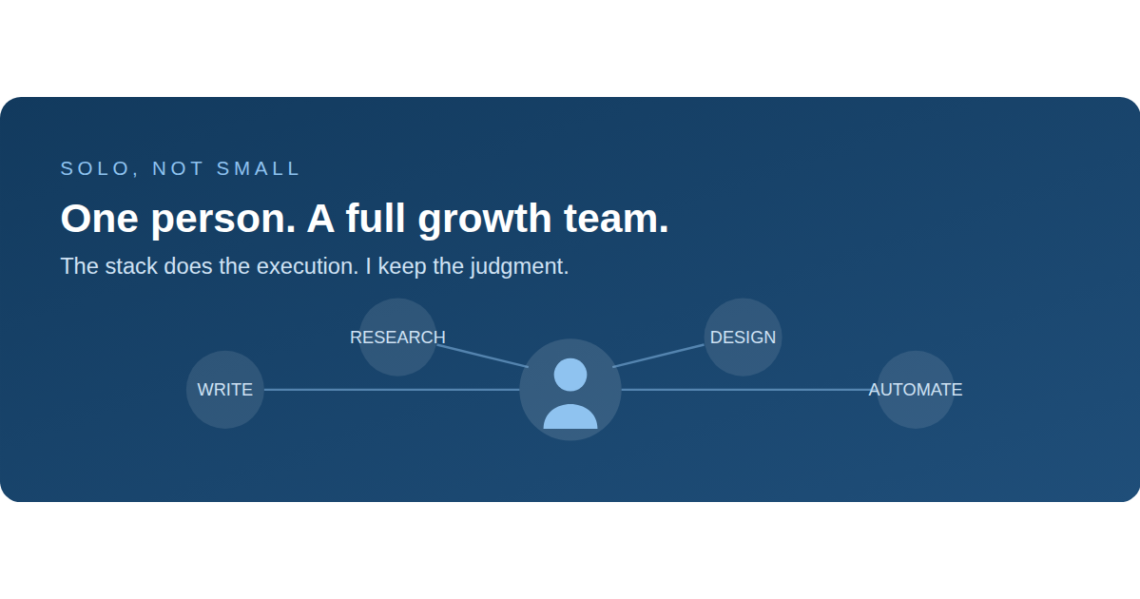
One person plus AI can run a full growth function — for execution. Drafting, design, research, reporting, and logging all compress dramatically. What doesn’t compress is judgment: picking the metric, designing the experiments, deciding what to kill. That part stays human. That part is the job.
Keep that split in mind through everything below. Every tool I use exists to buy back hours for the one task no tool can do.
My stack, by job
I organize tools by job, not by hype — the same rule from my 17 AI tools breakdown. Here’s what I personally run day to day:
| Job | What I actually use | How, in practice |
|---|---|---|
| Long-form writing | Claude | Every growth memo and article starts here — it holds nuance across long drafts |
| SEO & keyword research | Ubersuggest, MCP-connected to Claude | I ask Claude in plain English; it pulls live volumes, difficulty, and competitor keywords from Ubersuggest — no dashboard tab |
| Coding & shipping | Claude Code | Landing pages, automations, fixes — I describe, it builds, I review |
| Research & cross-checking | ChatGPT, Kimi, Meta AI | Market sweeps and competitor questions, asked across models so one model’s blind spot doesn’t become mine |
| Automation | A no-code automation layer | The glue: results flow into my experiment log without me touching it |
| Experiment log | One document, auto-updated | Every test: hypothesis, ICE score, verdict, lesson |
The Ubersuggest + Claude setup deserves a closer look, because it changed how I do SEO more than any tool swap before it.
MCP (Model Context Protocol) lets an AI assistant talk to your tools directly. So instead of exporting keyword CSVs and pasting them into a chat, I just ask: “Find low-difficulty keywords around Instagram DM automation that BuzzWire could rank for, and check what my competitors already rank on.” Claude queries Ubersuggest live and comes back with the shortlist — plus its reasoning. Keyword research went from an afternoon to a conversation.
Same story with Claude Code. When BuzzWire needed a comparison page, I didn’t open a ticket or a freelancer chat. I described the page, reviewed the code it wrote, shipped it. As a non-hands-on-keyboard-every-day founder, that’s the difference between “next sprint” and “this afternoon.”
For research I deliberately stay promiscuous: the same question goes to ChatGPT, Kimi, and Meta AI. They disagree more often than you’d think, and the disagreements are usually where the interesting truth hides. Writing, though, lives in one place — Claude — because depth in one model beats shallow access to five.
And the automation layer quietly does the boring miracle: it turned my weekly experiment log from a chore into something that stays current on its own. Monday reviews start with data, not data entry.
The three prompts I actually reuse
Prompt libraries are where most of the compounding lives. These three templates do more work for me than any tool subscription. Steal them.
1. The growth memo prompt
PROMPT — WEEKLY GROWTH MEMO You are my growth analyst. Here is this week's data: [paste metrics vs last week] and experiment verdicts: [paste results]. Write a short memo: (1) what moved and the likely why, (2) what flatlined, (3) the one lever that deserves next week's focus. Be blunt. No praise, no filler. If the data doesn't support a conclusion, say so.2. The experiment generator prompt
PROMPT — FILL THE ICE BACKLOG Context: [product one-liner, current North Star metric, weakest lever right now]. Generate 15 experiment ideas for that lever. For each: a one-line hypothesis in the format "Because [insight], we think [change] will move [metric] by [amount]", plus your 1-10 guesses for Impact, Confidence, Ease. Sort by ICE score. Flag any idea that would take more than a week to build.3. The repurposing prompt
PROMPT — ONE POST, FIVE ASSETS Here is my latest blog post: [paste]. Produce: (1) an X thread of 6-8 posts in my voice — short lines, pain-point hook, no hashtag spam, (2) three standalone single posts, (3) a LinkedIn version, (4) a newsletter intro paragraph, (5) three title variants for A/B testing. Keep every claim from the original — add nothing new.The pattern across all three: give the model real data and a tight output contract. Vague prompts produce vague marketing. Specific prompts produce drafts I can edit in minutes.
I’ve gone one step further and packaged my growth workflows as open-source agent skills — a 7-skill suite called PLG-Architect that walks from founder context through ICP research, competitive intel, strategy, viral loops, content, and metrics. It’s MIT-licensed at github.com/ranjeeetvimal/growth-skills, and it works with Claude Code, Cursor, Gemini CLI, and anything else that supports agent skills. One command: npx skills add ranjeeetvimal/growth-skills.
My weekly rhythm: the loop, solo
Tools without a system are just subscriptions. I run the same loop I’ve used for years — North Star + ICE + weekly review — shrunk to fit one person:
- Monday, one block: review the metrics against last week (the memo prompt drafts this), call win/loss on running experiments, pull the next 2–3 off the ICE backlog.
- Daily, short blocks: execution. AI drafts, I edit and ship. One experiment touched per day, minimum.
- Always-on: automations log results, capture leads, and file research in the background.
- Friday, 15 minutes: write the lesson of the week into the log. In my own words, not AI’s. This is the part that compounds.
BuzzWire is now the public test of this exact system. Every growth number it produces — good or ugly — gets published in the build-in-public series, so you’ll be able to judge whether the machine works by its output, not my claims.
What AI still can’t do (and I stopped asking it to)
Honesty section. After a couple of years of running this way, here’s where the stack ends:
- Choosing what matters. AI will happily generate 50 experiments for the wrong metric. Picking the North Star is judgment, earned the slow way.
- Taste. The last 20% of every draft — the part that sounds like a person — is still me, every time. Readers can tell. So can customers.
- Talking to users. AI summarizes conversations brilliantly. It cannot have them for you. The best growth insights still come from a human asking a customer “why?”
- Caring. A flat week doesn’t bother the stack. It bothers me. That discomfort is where the next good idea usually comes from.
AI compresses execution, not judgment. One person who understands that split can now do the output of five. One person who doesn’t just produces noise five times faster.
Steal this setup
If you’re a solo founder or a one-person marketing team, don’t copy my tools — copy the shape:
- One LLM you go deep on, with a saved prompt library. (Mine is Claude.)
- Your data tools connected to it via MCP, so research becomes conversation instead of tab-switching. (Mine: Ubersuggest for SEO.)
- An AI coding tool so small build tasks stop waiting for developers. (Mine: Claude Code.)
- Two or three other models on rotation for research, so you catch each one’s blind spots.
- One automation layer wiring results into one experiment log, and one weekly loop turning it all into decisions.
- And if you want a head start: install my free Growth Skills and let your agent run the same playbooks I use.
Start with the three prompts above and the framework post. The whole thing costs less per month than a single agency invoice — and it gets smarter every week you run it.
Frequently Asked Questions
Can one person really run a full growth team with AI?
For execution, yes. Drafting, design, research, and reporting compress enough that one person ships what used to need a team. Judgment — choosing metrics, designing experiments, deciding what to kill — stays human. The combination of one person, an AI stack, and a clear weekly system covers both.
What does a one-person AI growth stack cost per month?
Roughly $40–100/month for a working setup: one LLM subscription (~$20), an automation platform (~$10–30), plus free tiers for research, design, and meeting notes. Add one paid specialist only where your funnel actually leaks.
Which AI tool is best for writing growth content?
The one you learn deeply. I draft every long-form growth memo in Claude first — it holds nuance across long documents — and I’ve connected my SEO data (Ubersuggest) to it via MCP, so drafts get written with live keyword data in the room. Plenty of people run the same system on ChatGPT. The prompt library matters more than the logo.
How do you connect SEO tools to an AI assistant?
Through MCP (Model Context Protocol) — a standard that lets assistants like Claude query your tools directly. I’ve connected Ubersuggest this way: I ask for keyword opportunities in plain English and Claude pulls live search volumes, difficulty scores, and competitor rankings. No exports, no dashboards, no copy-paste.
How many hours a week does this take?
One Monday planning block, short daily execution blocks, and 15 minutes of Friday reflection — with automations running in the background. The win isn’t fewer hours; it’s that the same hours ship several times more experiments.